What I Took Home from Firm Growth Forum East 2026: Specialize, Consolidate, and Watch WIP in Real Time
Steven Duc Tran, CPA, CIA ·
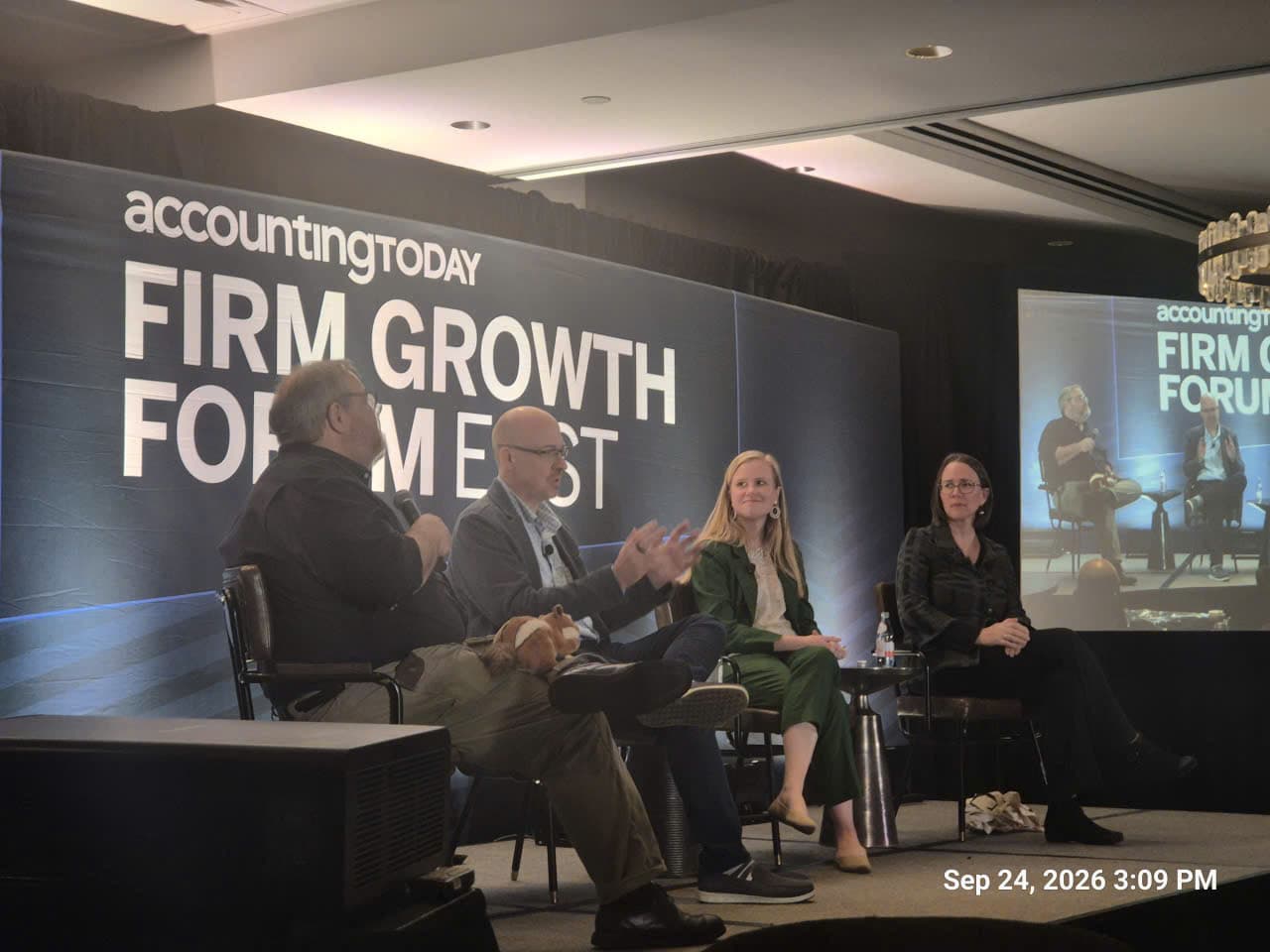
I spent two days in Washington, DC at Accounting Today's Firm Growth Forum East with managing partners, CEOs, and firm technology leaders. The sessions circled one question: what separates the firms that scale from the firms that stall. These are my notes on the answers, with the speakers described by role.
1. The firms that scale chose a specialty before they could afford one
Every growth story in the room began with a niche selected while the firm was still too small to justify it.
One managing partner described building an automotive dealership practice from 20 clients to 75, then testifying before the IRS and speaking at industry events. The practice now serves more than 400 dealerships, including some of the largest in the country. The firm repeated the approach for government and nonprofit work, each time finding the person inside the firm with a genuine interest in the industry. The stated goal: know a lot about a little.
That firm also never divided staff into tax and audit. New hires rotate through the practice groups, handling audit work, business returns, and closely held clients, until they find their industry. By then they understand the full range of services a client needs.
A growth consultant on a later panel gave the reason to start early. Competition arrives, margins fall, and a general practice has nowhere to go. Specialize from the beginning.
2. Firms run far more software than they use
A technology leader put numbers on something I see in most engagements. Small firms run about 25 systems. Larger firms run 80 to 100. His own firm counted 82 applications, and he estimated that most firms use about 40 percent of what they pay for, with much of the remaining effort spent moving data from one system to another.
His framework for sorting that out was the most useful idea of the two days. Classify every application as one of three:
- Preferred. It does what you need, and it will still do it in three to five years.
- Tolerated. It works today, and that is all.
- Consolidate. Retire it.
Then know where your systems of record are. His test for any new purchase: does this software help us maintain and clean our data, and make it accessible to other tools? AI, he noted, builds on whatever data it can reach, so the value of AI in a firm is capped by the quality and accessibility of that data.
The managing partner of a smaller firm reviews the full technology stack monthly and keeps reaching the same conclusion: not another tool that does one thing, but one that does five. Her rule is to examine the process first and then choose the technology that supports it. Most new tools automate a flawed process faster.
3. Real-time WIP is a growth lever, not a back-office metric
The same technology leader named technology the defining trait of a high-performing firm, because it is the shortest path to efficiency, and efficiency is the shortest path to profit. His most concrete example: compare WIP to budget in real time, flag an engagement the moment it drifts, and renegotiate with the client while the engagement is still profitable.
A practice management consultant added a caution on measurement. Higher realization does not mean higher contribution. Choose the KPI that reflects what the firm is trying to grow.
4. Advisory grows from client needs, not from a plan
A CEO whose firm built a substantial advisory practice traced every service line to a client situation. A tax client's divorce led to litigation support. A young staff member who kept flying to Silicon Valley became the leader of a digital services group that grew from $6 million to $100 million. His guidance on starting was direct: the leader comes first, hire industry expertise if you must, and expect the first clients to take 12 to 24 months.
A retired CEO who helped grow a consulting arm from $5 million to $110 million agreed, and added a caution. Everything must align with the written strategy, and an early advisory practice can drift away from the compliance partners who feed it. Both sides have to want the referral.
5. On AI, the firms that waited are glad they did
Firms split into two camps early. Some adopted ChatGPT as soon as it was free. Others waited for Copilot to mature, with security as part of the strategy from the start rather than a policy added later. When the data breach stories arrived, the second group knew they had chosen well.
One managing partner in that camp described a rollout that held: a small control group, Copilot only, an AI policy written before launch, a hired trainer, and a fifteen-minute innovation spotlight every Thursday where staff show what they built. Her firm also runs a peer-nominated innovation award in which partners and principals are not eligible. The difficulty, she acknowledged, was that ChatGPT was free, and some staff used it until the policy and training caught up.
A CIO on another panel offered the counterpoint. An AI-drafted answer to his board read well, was wrong, and had to be rewritten. The corrected version, still recognizably AI-assisted, was better received than his usual writing. AI is not the enemy, he concluded, but it needs a reviewer. A third leader stated the constraint plainly: AI is only as valuable as the data it can reach.
What I am bringing home
- Real-time WIP is the first dashboard to build. It was the one metric the room agreed on, and it is what the Firm Overview dashboard in Dashboard 4 CPA provides: WIP against budget refreshed daily from CCH Axcess or Practice CS, unprofitable clients surfaced before the write-off, and performance by industry, office, or partner so a firm can see which specialty is working. It also exposes the data problems underneath, such as inactive clients still carrying AR or duplicate records, that must be resolved before any number can be trusted.
- Establish the source of truth before the strategy. The preferred, tolerated, consolidate framework now belongs in my first conversation with a firm. Much of my work is this groundwork: data clean-up across client, contact, and staff records, and integrations that keep one system of record current, so the analysis behind a growth decision rests on numbers the partners trust.
- Specialization is a data question. Every growth story began with a niche, and no system report will show a firm which industry is most profitable or which clients no longer fit. That visibility is the reporting work I do. This week made clear it is a growth decision, not an accounting one.
I left Washington with a clearer view of what growing firms have in common. For the better part of ten years, my work for CPA firms has been the groundwork this room kept returning to: trustworthy data, connected systems, and the visibility to act on both. Hearing it named as the foundation of growth, by the people doing the growing, is the best confirmation I could ask for that Silver Sea is pointed the right way. I am proud to have played a part in my clients' growth, and I intend to keep earning it.
If any of this sounds like your firm, I would welcome the conversation.
- Firm Innovation
- Firm growth
- Technology strategy
- Advisory