
Silver Sea AI & Automation
CCH Axcess

Build the firm you meant to run. Start with CCH Axcess™.

Most firms use a fraction of what the Axcess suite already holds. We build the integrations, automations, and dashboards that turn that data into work getting done.

Axcess TaxAxcess PracticeWorkstreamDocumentDAUClient onboardingTax data entryQuickBooks syncPower BI dashboardsDAU alertsSilver Seaon CCH Axcess
Where does Axcess cost you the most time?

Four places firms usually start

01

Tax season eating your staff?

Onboarding, data entry, document chasing, and e-file tracking done by hand, every return, every year.

See how we help
02

Billing and client data don't add up?

Invoices re-keyed, AR chased manually, and client records that drifted apart years ago.

See how we help
03

Moving systems or merging firms?

Workstream, documents, and client records that have to move without a lost weekend or a lost file.

See how we help
04

Can't see the numbers without running a report?

The data is in Axcess. Getting it in front of partners as decisions, WIP against budget, profitability by client and industry, is the missing piece.

See how we help
01 · Tax season eating your staff

The busy-season work that shouldn't need a person

The Axcess suite already holds the client, the return, and the document. We connect them so staff review exceptions instead of typing.

  • Client onboarding from 30–45 minutes to under 2, with the record created in Axcess and your CRM at once.
  • Tax data entry from source documents, 3–10 hours saved per return.
  • PBC lists and reminders that go out on schedule, and incoming documents matched to the right client.
  • Signed SafeSend documents filed into the client's Axcess file automatically.

Case studies from this stage

  • Client onboarding in one formThe API now covers 90% of data points. Record creation takes 7–10 minutes instead of 30.
    Problem
    New clients were keyed separately into Smartsheet, CCH Axcess, CCH Workflow, and HubSpot, with no way to tell whether a lead already existed.
    Built
    A matching algorithm across all four systems, an API connection from Smartsheet into Axcess, and an RPA layer for the gaps.
    Result
    The API now covers 90% of data points. Record creation takes 7–10 minutes instead of 30.
  • Tax data import with validationDuplication errors gone; staff see document and e-filing status in real time.
    Problem
    Excel-to-Axcess imports produced entity mismatches and duplicates; document requests and e-filing status were tracked by hand.
    Built
    An import layer with entity matching and validation rules, plus a client portal for document tracking and e-file status through the SafeSend API.
    Result
    Duplication errors gone; staff see document and e-filing status in real time.
  • Signed SafeSend documents filed into CCH AxcessSigned documents reach the client's file without anyone touching them, and a network failure retries instead of losing the document.
    Problem
    Signed documents came back through SafeSend and had to be moved into CCH Axcess by hand.
    Built
    A service that acknowledges SafeSend's notification immediately, then downloads and files the document in the background through a job queue.
    Result
    Signed documents reach the client's file without anyone touching them, and a network failure retries instead of losing the document.
  • Engagement letter automationLetter generation cut to 2–3 minutes in testing, and a $505,000 product-code mismatch surfaced and fixed along the way.
    Problem
    The existing engagement letter automation was outdated, disconnected from daily systems, and ran off 38 largely duplicated templates.
    Built
    An internal portal integrating Salesforce, CCH Axcess Workflow, SafeSend/Adobe Sign, and SharePoint, with one product-code-driven master template.
    Result
    Letter generation cut to 2–3 minutes in testing, and a $505,000 product-code mismatch surfaced and fixed along the way.
02 · Billing and client data don't add up

Get paid faster, from data that reconciles

Most billing problems in Axcess are data problems first. We fix both ends.

Billing, AR, and cash flow

  • Progress invoices allocated to the right projects automatically.
  • Client and invoice records synced to QuickBooks Online, no re-keying.
  • AR reminders and card payments triggered by aging; write-offs validated against source records.

Client data you can trust

  • Bulk client, contact, and staff updates reviewed in Excel, then written back in one pass.
  • Client portal users added and removed by bot, with a log of every change.
  • Inactive clients, duplicates, and old binders found and cleaned up by rule, not by memory.

Case studies from this stage

  • AR reminders and data clean-upIdentified $53,000–$54,000 in AR tied to inactive clients that reporting had been missing.
    Problem
    Inactive clients with outstanding AR, duplicate metadata, and overlapping staff fields were quietly distorting reporting.
    Built
    A structured clean-up pass across client, contact, and staff records, with a plan for an AI data-integrity agent to keep it clean.
    Result
    Identified $53,000–$54,000 in AR tied to inactive clients that reporting had been missing.
  • WIP and AR reconciliation after a mergerSurfaced a $230,000 AR discrepancy and an $868,000-vs-$5 million WIP reporting mismatch that no report had shown.
    Problem
    After a merger, the firm couldn't reconcile WIP and AR balances across offices. The existing reports hid the gaps.
    Built
    A WIP/AR reconciliation analysis on DAU data and a monthly reconciliation workflow.
    Result
    Surfaced a $230,000 AR discrepancy and an $868,000-vs-$5 million WIP reporting mismatch that no report had shown.
  • Financial Cents time synced into CCH Axcess PracticeCAS hours reach CCH Axcess on a known schedule, earlier on Mondays so partner reports cover the prior week. A daily comparison also flags clients, projects, and service codes that exist in one system and not the other.
    Problem
    The CAS department logged time in Financial Cents while billing, WIP, and realization lived in CCH Axcess Practice, so someone re-entered the week's time by hand. CCH Axcess has no API for time entry import.
    Built
    A daily run that pulls recent entries through the Financial Cents API, maps clients by ID, staff by email, and service codes and projects to CCH's naming, then emails each person their own entries with errors flagged. Two hours later a Power Automate bot imports the cleaned data through the CCH Axcess screens. The administrator replies "Resync" to rerun a day, and entries already imported are skipped.
    Result
    CAS hours reach CCH Axcess on a known schedule, earlier on Mondays so partner reports cover the prior week. A daily comparison also flags clients, projects, and service codes that exist in one system and not the other.
    Read the full case study
  • Time-entry monitoring and importRemoved the SQL database and the manual spreadsheet, and closed the loop so the source system knows an import succeeded.
    Problem
    Time batches from an external system were keyed into CCH Axcess by hand; an earlier automation depended on a fragile SQL database and a manual spreadsheet.
    Built
    A Power Automate Desktop pipeline: JSON batches arrive over Azure Service Bus, become Excel via Office Scripts, and a bot completes the import, then reports back.
    Result
    Removed the SQL database and the manual spreadsheet, and closed the loop so the source system knows an import succeeded.
  • Bulk client updates in CCH Axcess from ExcelA clean-up or migration that would take administrators weeks of one-record-at-a-time edits runs as a reviewed batch.
    Problem
    After years of use, mergers, and setups that no longer fit, client data was cluttered enough that reports were slow and sometimes wrong.
    Built
    A Python update process that uses Excel as the staging area: the firm reviews and corrects the data in a spreadsheet, and the tool applies the changes to CCH Axcess Practice in bulk.
    Result
    A clean-up or migration that would take administrators weeks of one-record-at-a-time edits runs as a reviewed batch.
  • Client portal access managed by botPortal access changes run in bulk, and every change is logged as a success or an error.
    Problem
    Portal users had to be added and removed client by client, by hand.
    Built
    An RPA bot that reads add and delete requests from an Excel file and applies them across multiple clients.
    Result
    Portal access changes run in bulk, and every change is logged as a success or an error.
  • Engagement binder purge by retention rulesPhase one alone removed roughly 3,800 audit binders and freed about 380 GB.
    Problem
    Years of closed engagement binders were eating storage, and the firm had no formal purge process.
    Built
    A phased purge of audit, tax, and ACS files by retention criteria, plus a bot that adds admin users to client portals.
    Result
    Phase one alone removed roughly 3,800 audit binders and freed about 380 GB.
What makes Axcess different

Three things a developer learns the hard way

01

The modules are licensed separately

A firm can own Tax and not Document, so an integration has to check what the firm licenses before it assumes a feature is there.

02

There are two ways to sign in to the API

A modern one and a legacy one, and which calls accept which isn't obvious until you have built against both.

03

There is no sandbox

Everything is built and tested against the firm's live database, which is why we test on a sample first and keep a trail of every change.

03 · Moving systems or merging firms

Moves planned like an audit, not a copy-paste

We map the structure, test on a sample, and keep both systems running until staff are ready, so there is no cutover day to dread.

  • Workstream migration by RPA bot, 2,000+ projects on one engagement.
  • Document history moved into SharePoint with folder structure and metadata intact, then kept in sync through the API.
  • One client record across Axcess and Karbon, with every change approved before it applies.

Case studies from this stage

  • Workstream and project migration by bot2,000+ projects processed on one engagement.
    Problem
    Thousands of projects had to be created in Workstream with no import path that preserved the firm's structure.
    Built
    An RPA bot creating Workstream projects from an Excel list, with validation on each record.
    Result
    2,000+ projects processed on one engagement.
  • CCH Axcess Document history moved into SharePointThe firm's document history landed in SharePoint in one structure, and the two systems run side by side, so the firm adopts SharePoint at its own pace instead of on a cutover date. If a metadata column is missing, the upload continues and logs a warning, so a night's transfer is never lost.
    Problem
    About 40 export archives needing roughly 200 GB of working space, folder trees longer than Windows' 260-character path limit, and the same client spread across several archives.
    Built
    A pipeline that unpacks each archive, drops CCH's internal wrapper folders, merges each client into one SharePoint folder, skips documents older than seven years unless they are marked Permanent, and applies classification metadata after each upload. After the bulk move, a sync tool pulls new files from CCH Axcess through the API.
    Result
    The firm's document history landed in SharePoint in one structure, and the two systems run side by side, so the firm adopts SharePoint at its own pace instead of on a cutover date. If a metadata column is missing, the upload continues and logs a warning, so a night's transfer is never lost.
  • Document migration into SharePointProjected timeline cut from 12 weeks to 2–3 by using API tooling instead of a manual move.
    Problem
    1.2 million documents for about 11,000 clients had to leave GoFileRoom, prioritizing active clients and the last seven years.
    Built
    A staged pipeline (download, restructure, upload) run by ten RPA bots on ten virtual machines in parallel, with a redesigned client data model.
    Result
    Projected timeline cut from 12 weeks to 2–3 by using API tooling instead of a manual move.
  • One client record across CCH Axcess and KarbonLive in production. One place to look instead of cross-referencing two systems by hand, and every failure raises a notification and a visible status record, so nothing fails silently.
    Problem
    Staff checked two systems to get a complete picture of a client. The two systems use different ID and contact structures.
    Built
    A client management tool that creates a client in both systems at once, compares the two records side by side, and applies a change only after someone approves it. It keeps the firm's 5-digit client IDs and Karbon's organization-plus-person contacts, and runs on the firm's own server behind Microsoft 365 sign-in.
    Result
    Live in production. One place to look instead of cross-referencing two systems by hand, and every failure raises a notification and a visible status record, so nothing fails silently.
04 · Can't see the numbers without running a report

The numbers, current and in one place

Everything below runs on the Axcess data you already have.

Dashboards on live Axcess data

  • Power BI dashboards on live Data Axcess Utility (DAU) data.
  • DAU monitoring that alerts you when a refresh fails, before partners notice.

Reports without the setup

  • Axcess reports configured, run, and exported to Excel by bot, the same way every time.
  • Ask a question in plain English and get the client or return details back, through an AI assistant on the Axcess API.

Case studies from this stage

  • DAU monitoring and Power BI infrastructureCredential expiry removed as a single point of failure.
    Problem
    Reporting on the Data Axcess Utility relied on credentials that expired every 60–90 days, causing repeated refresh outages.
    Built
    A move to centrally managed infrastructure, a ticketing process for Power BI permissions, and a row-level security plan.
    Result
    Credential expiry removed as a single point of failure.
  • CCH Axcess reports exported to Excel by botReports come out the same way every run, without anyone rebuilding the settings.
    Problem
    Setting up a CCH Axcess report meant re-entering parameters and selection criteria by hand, which was slow and easy to get wrong.
    Built
    An RPA bot that configures the parameters, selects the criteria, runs the report, and exports it to Excel.
    Result
    Reports come out the same way every run, without anyone rebuilding the settings.
  • AI assistant connected to your practice systemA multi-step lookup across two platforms became one plain-English request.
    Problem
    Checking data quality or creating work items meant digging through each platform's UI separately.
    Built
    An MCP-connected assistant wired into both platforms that runs data-quality audits, creates work items, and pulls documents from SharePoint.
    Result
    A multi-step lookup across two platforms became one plain-English request.
  • Dashboard 4 CPABroken links gone; partners and billers each get a workspace scoped to what they're allowed to see.
    Problem
    Dashboard links broke whenever reports changed, and nothing separated what partners see firm-wide from what billers should see.
    Built
    A Power BI suite with a stable published link, role-based partner and biller workspaces, and one consolidated staff dashboard.
    Result
    Broken links gone; partners and billers each get a workspace scoped to what they're allowed to see.
04 · A worked example: Dashboard 4 CPA

Six Dashboards Your Partners Will Actually Open On Monday Morning

Built on the CCH Axcess data you already have. Deployed in as little as two weeks.
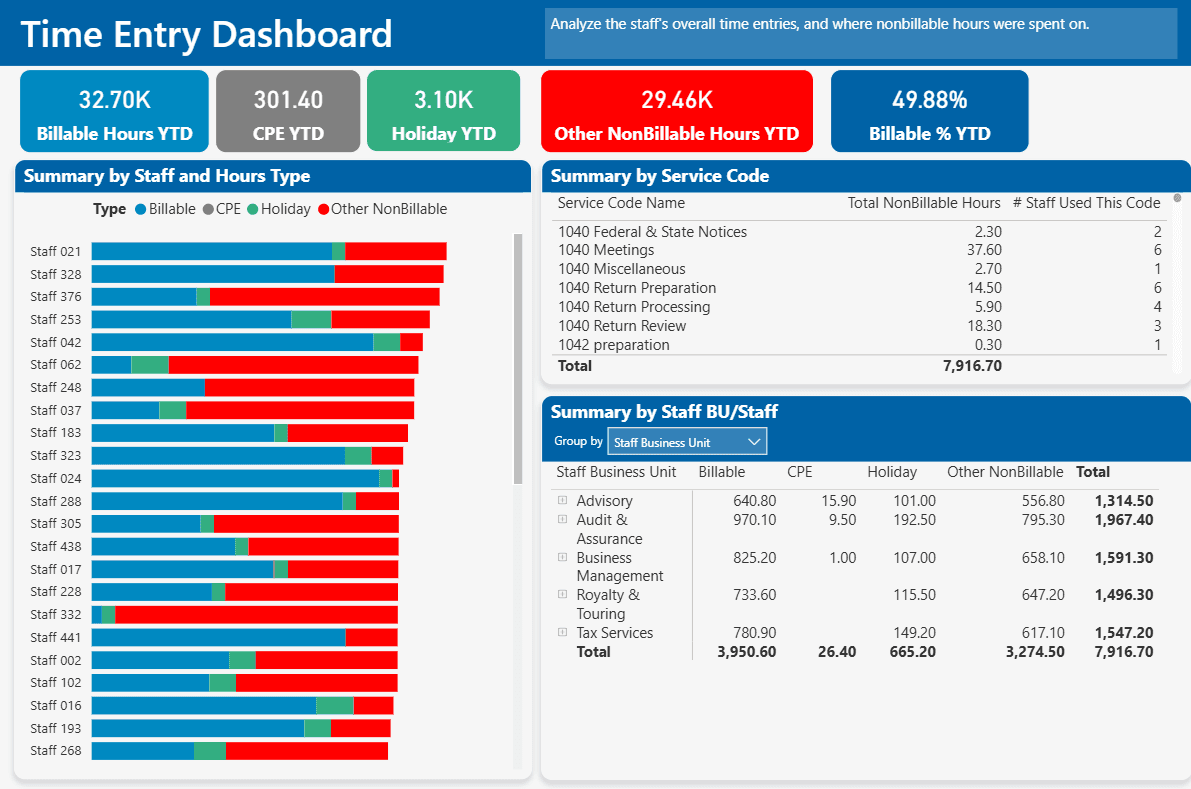
Time Entry dashboard

Time Entry

Where every hour goes, in one view

Staff time across billable, CPE, holiday, and non-billable categories, so leadership can see where capacity is being absorbed.
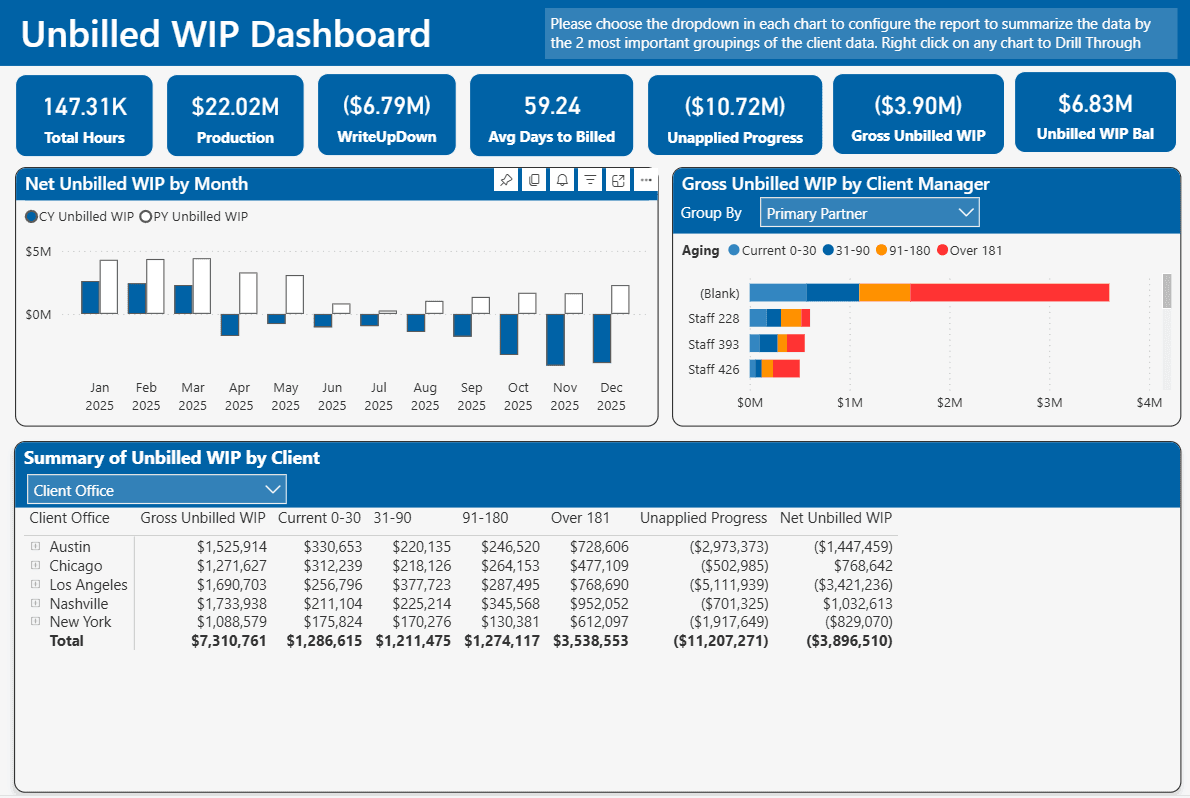
Unbilled WIP dashboard

Unbilled WIP

Aged, and still actionable

Unbilled work aging by partner before it turns into a write-off, broken out current, 31 to 90, 91 to 180, and past 181 days.
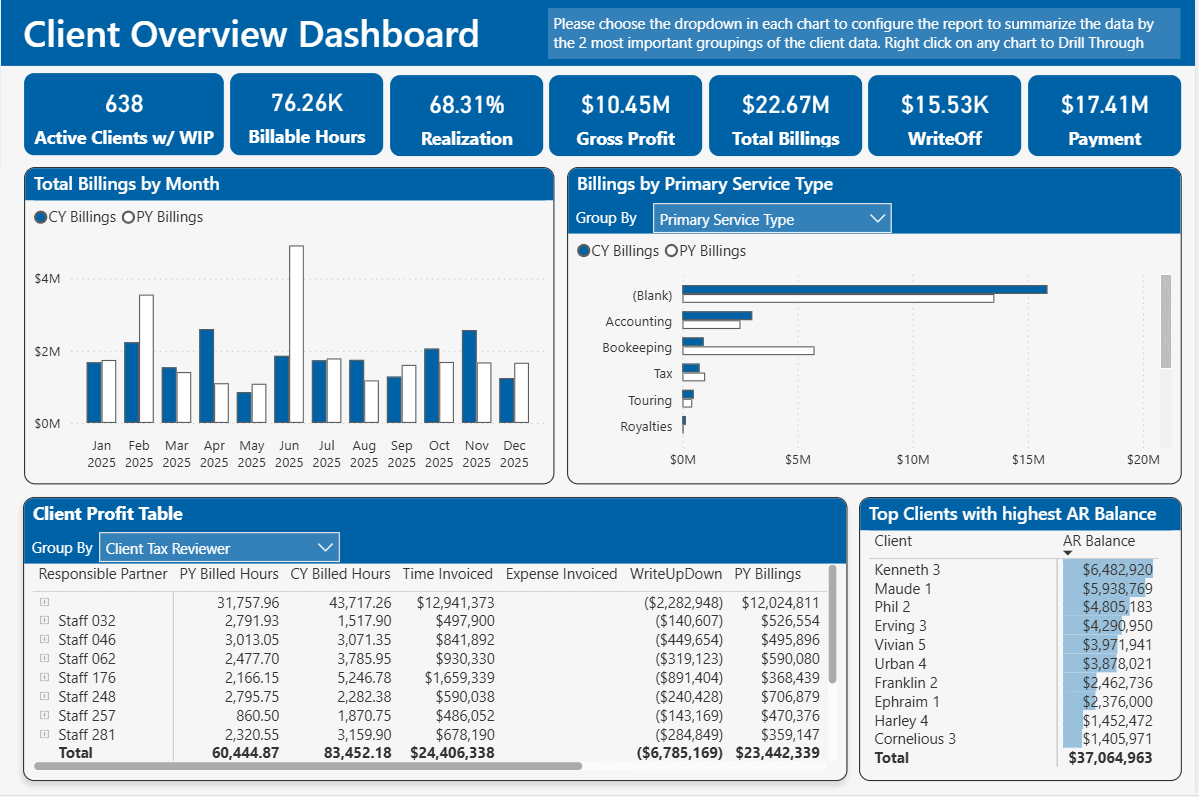
Client Overview dashboard

Client Overview

Performance, client by client

Profitability, billing trends, and AR exposure at client level. Slice by office, service type, or responsible partner.
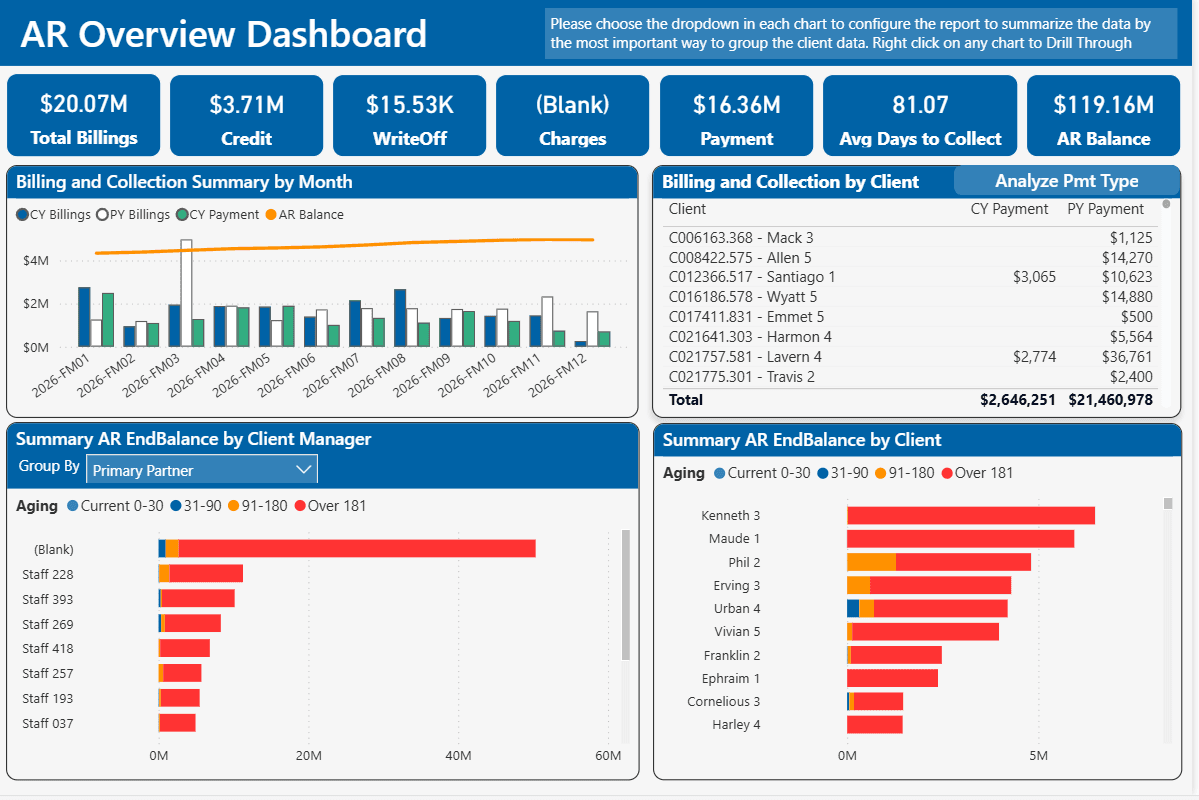
AR Overview dashboard

AR Overview

Collections, Aged And Segmented

The full receivable pipeline from billing to collection, with aging breakdowns by client, manager, and payment type.

FAQ

Common questions

Does CCH Axcess have a sandbox or test environment?

No. CCH Axcess does not offer a sandbox, so every integration is built and tested against the firm's live database. We test on a small sample of records first, keep a log of every change, and only then run at full volume.

Does CCH Axcess have an API?

Yes, but it doesn't cover everything. Client, tax, and document data are available through the API. Some functions, including time entry import in CCH Axcess Practice, have no API at all. For those we use a bot that works through the same screens your staff use.

What is the Designated Vendor Integrator Key?

It is a separate API credential for outside developers, announced by Wolters Kluwer in September 2026. Before it, a vendor had to use the same key as the rest of the firm. A dedicated key lets the firm identify, authorize, and govern each integration separately.

Can CCH Axcess Document files be moved to SharePoint?

Yes. We run a one-time bulk migration that keeps folder structure and metadata, skips documents past the retention period unless they are marked permanent, and then keep new files in sync through the API. Staff can keep working in CCH Axcess while the firm adopts SharePoint at its own pace.

Can another practice management tool feed time into CCH Axcess Practice?

Yes. We have built this for Financial Cents at two firms. Time entries cross every day. Each staff member reviews their own entries first, and then a bot imports them. Billing, WIP, and realization stay in CCH Axcess without anyone re-keying.

Does CCH Axcess integrate with the other systems we use?

Usually not out of the box. CCH Axcess has few ready-made integrations compared with newer platforms such as Karbon, which were designed from the start to connect to other software. For planning, assume a connection will have to be built rather than switched on, and budget for it.

Can we get the reports we need out of CCH Axcess?

Usually yes. The data sits in a solid database, so a custom report is typically a quick turnaround. The built-in client reports are limited: a standard client list gives the ID, the name, and one email address. Every email, full mailing addresses, and other detail in one place takes a custom report. Project and workflow reporting is stronger.

What is the Data Axcess Utility, and do we need it?

It is an add-on that copies your CCH Axcess data into a database, which makes extracting and reporting on it far easier. With it, most data questions are straightforward. Without it, some data is still reachable but several things get much harder, so it is one of the first things to establish on any CCH data project.

Our client ID numbers encode the office and partner. Should we keep that?

Question it before carrying it forward. These schemes were often designed when the firm was much smaller, and the ranges get stretched as the firm grows. Ask whether it still helps you manage the client list or is followed out of habit. If you keep it, have the system assign the number, because a manual step there cascades into everything downstream.

Steven Duc Tran, CPA, CIA

Ready to use the rest of CCH Axcess?

Book a free call. We'll review your setup and find the highest-ROI starting point for your firm.